


15 Best Low Taper Fade with Textured Fringe Hairstyles for Men
15 Best Low Taper Fade with Textured Fringe Hairstyles for Men (2026)
A low taper fade with textured fringe combines clean hairline tapering around the temples and nape with piecey, layered volume across the forehead. Most men struggle with this haircut because their barber takes the fade line past the ear crest or cuts the front baseline blunt.
This guide delivers 15 distinct cut styles, exact clipper guard formulas, and a blow dry routine that prevents fringe separation throughout the day.
What Is a Low Taper Fade with Textured Fringe?
A low taper fade with textured fringe is a haircut where the sideburns and neckline are faded down to skin while leaving length, weight, and scissor cut texture through the top and bangs. Unlike an all around skin fade, the fade perimeter stays confined to the lowest inch of the hairline.
The top sections are point cut rather than cut straight across. This technique leaves variable lengths between 2.5 and 4 inches, allowing the hair to fall forward in separated clusters instead of a solid shelf.
Because bulk remains along the parietal ridge, this style preserves natural head shape while framing the forehead. It adapts directly to straight, wavy, and thick hair types without exposing bare scalp above the ear.
Why the Low Taper Fade Fringe Is Dominating 2026 Men’s Hair Trends
Men’s grooming shifted away from high shine, rigid pompadours toward matte, textured motion. The low taper fringe leads this shift because it looks intentional without appearing stiff or over styled.
Social media trends accelerated adoption among younger demographics who want forward volume that survives a gym session or a windy walk. A quick scrunch resets the shape in seconds.
The cut also works across casual and professional settings. Clean edges around the ears and collar keep the perimeter sharp for corporate environments, while the textured top adds casual, modern styling flexibility.
15 Best Low Taper Fade Textured Fringe Ideas
High Volume and Fluffy Fringes
1. Classic Fluffy Low Taper Fringe
Best For: Straight or wavy hair on oval and oblong face shapes.
Popular with / Recommended by: British and North American street style creators.
This variation relies on 3 inches of top length point cut at a 45 degree angle to create natural lift. The sideburns start at a #0.5 guard and blend into a #2 open at the temple peak, keeping the perimeter neat.
Prestyling with sea salt spray on damp roots gives the hair lift without adding greasy weight. Finish by scrunching a dime sized amount of matte styling clay through dry ends to lock in separation.

2. Messy Textured Fringe Blowout
Best For: Thick, dense hair on square and round face shapes.
Popular with / Recommended by: College athletes seeking casual volume.
This cut blends a temple taper with an expanded crown silhouette that carries volume toward the back. The barber leaves 3.5 inches through the front, tapering down to 2.5 inches toward the swirl.
Dry the hair upside down using a diffuser attachment on medium heat to lift the roots. Once dry, shake texture powder directly into the crown to prevent the bulk from collapsing midday.

3. Airy Straight Hair Volume Fringe
Best For: Fine, pin straight hair needing faux density.
Popular with / Recommended by: Modern K-pop and East Asian hair stylists.
Straight hair tends to fall flat against the forehead unless interior weight is removed with thinning shears. The barber slide cuts the interior while keeping the exterior fringe ragged and piecey.
The low taper starts with a #1 guard on the sideburns, avoiding bare skin to keep the side profile looking dense. A vented brush lifts roots while blow drying, creating airy movement across stubborn straight strands.

4. Disconnected Heavy Fringe Taper
Best For: Oval faces with coarse hair textures.
Popular with / Recommended by: Editorial fashion stylists.
This design keeps the top fringe heavy and overhangs the side taper slightly without a direct shear blend. It creates a bold top silhouette while the neckline remains cleanly tapered with a #0 blade.
Keep the front fringe sitting right above the eyelashes. Rub a light styling paste between your palms and pick through individual sections to emphasize the separated, chunky aesthetic.

Short and Cropped Textured Fringes
5. Short Textured French Crop Hybrid
Best For: Receding hairlines or high foreheads.
Popular with / Recommended by: Active professionals and runners.
A blunt fringe draws attention to uneven corners, but this micro textured crop breaks the line with deep point cutting. The front reaches 1.5 inches, sitting midway down the forehead.
The low taper is carved tight to the ears using a #0.5 guard, blending into the top in under two inches of vertical space. It requires zero blow drying and sets instantly with texture dust.

6. Angular Choppy Fringe
Best For: Round and heart face shapes.
Popular with / Recommended by: European streetwear trendsetters.
Instead of falling straight down, the fringe is cut on a subtle diagonal slant from left to right. This angle visually breaks up circular jawlines and creates asymmetric contrast.
Keep the nape taper squared off at the base to complement the sharp angular lines of the front fringe. Use a matte paste to pinch the longer corner forward into defined spikes.

7. Caesar Inspired Low Taper Fringe
Best For: Men wanting maximum structure with minimal upkeep.
Popular with / Recommended by: Classic barbershop traditionalists.
This style keeps uniform length across the top (roughly 2 inches) and works the front forward into short, choppy points. The hairline remains defined without appearing like a solid bowl cut.
The sideburn taper starts completely bald at the tragus before expanding into a #1.5 guard. It holds its silhouette for up to four weeks without awkward puffing around the ears.

8. Micro Fringe with Razor Taper
Best For: Diamond face shapes and defined cheekbones.
Popular with / Recommended by: High fashion barbers.
The fringe stops two inches above the eyebrow line, heavily notched with a straight razor for serrated texture. The temples and nape receive a razor finish, providing the tightest perimeter possible.
This cut demands a confident jawline, as the short front exposes the entire upper face. A quick dash of texture spray keeps the short spikes standing upright.

Texture Specific Fringes (Wavy, Curly, and Coarse)
9. Natural Wave Forward Fringe
Best For: Type 2A to 2C wavy hair patterns.
Popular with / Recommended by: Coastal and surf culture stylists.
Wavy hair naturally clusters, making it ideal for the low taper fringe structure. The barber cuts the top dry to account for natural bounce, leaving about 3 inches of relaxed length.
The taper stays low around the perimeter so natural wave patterns remain visible above the ears. Apply sea salt spray to damp strands and let the hair air dry naturally.

10. Messy Curly Low Taper Fringe
Best For: Type 3A and 3B spring curls.
Popular with / Recommended by: Modern urban barbers.
Curls shrink between 30% and 40% as moisture evaporates, so the fringe must be cut past the bridge of the nose when wet to sit at the eyebrows when dry.
A skin taper at the neckline cleans up stray neck hairs without disrupting the crown curl bundle. Work a leave in curl cream through the fringe to eliminate frizz while keeping individual ringlets defined.

11. Coarse Hair Textured Crop Fringe
Best For: Thick Asian and Hispanic hair profiles.
Popular with / Recommended by: West Coast precision barbers.
Coarse strands tend to stick straight out when cut short. The barber must perform scissor over comb texturizing to carve out internal weight while preserving length to weigh the hair down forward.
The low taper should start soft with a #1 guard rather than skin to prevent bristly grow out along the perimeter. Style using a water based matte paste with firm hold to keep coarse strands directed forward.

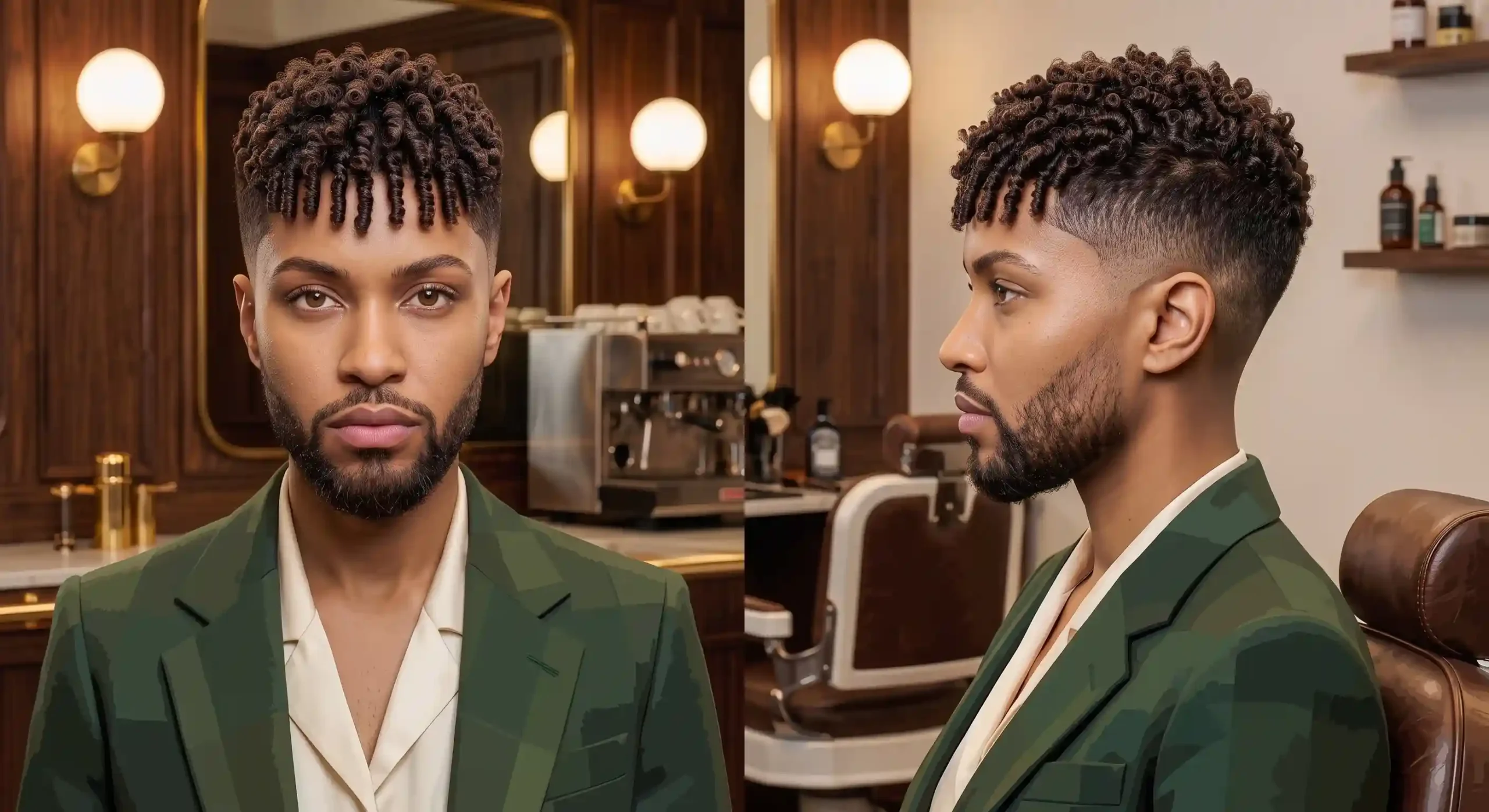
12. Tight Coil Low Taper Fringe
Best For: Type 4A to 4C hair textures.
Popular with / Recommended by: Black barbershop master stylists.
This design pairs a crisp temple edge up with a low taper, allowing defined coil clusters to fall over the forehead. The front baseline is lightly picked and shaped to sit evenly across the brow.
A curl sponge worked in circular motions over damp hair defines the top coils in under a minute. Daily hydration with light hair oil keeps the scalp and fringe supple.
Modern Hybrid Fringes
13. Low Taper Mullet with Textured Fringe
Best For: Edgy styles and creative settings.
Popular with / Recommended by: Indie rock and alternative artists.
This cut tapers only the sideburn area, leaving substantial length through the back collar and crown. The front features a jagged, choppy fringe that balances out the longer rear silhouette.
Use texturizing powder at both the front hairline and the rear nape layers to build matching gritty texture throughout the profile.

14. Temple Taper with Messy Shag Fringe
Best For: Medium density hair with cowlicks.
Popular with / Recommended by: Casual college students.
Taking inspiration from 90s skater cuts, this style leaves 4 inches on top with feathered, piecey layers. The taper is isolated to the temporal points, creating a soft transition that grows out gracefully.
Rough up the hair with your hands while blow drying on low heat without using combs or brushes. The messier the finish, the better this cut presents.

15. Tapered Edgar Hybrid Fringe
Best For: Straight, thick hair on angular faces.
Popular with / Recommended by: Southwestern trend barbers.
Unlike a traditional blunt Edgar cut, this version softens the front line with deep vertical point cutting. The horizontal profile remains distinct, but the texture prevents it from looking helmet like.
The low taper sits tight behind the earlobes, maintaining high contrast between the thick top canopy and the clean neckline. Set with a light dusting of silica powder for all day separation.

How to Choose the Right Fringe for Your Hair Texture
Pin Straight Hair
Straight hair lacks natural curvature, making it prone to falling into a flat curtain. Request deep point cutting to create uneven lengths that catch against each other. Rely on silica based texture powder rather than pomades, which weigh straight follicles flat.
Wavy Hair
Natural waves provide built in movement that reduces daily styling time to two minutes. Keep top length between 2.5 and 3.5 inches so the wave can complete a full bend. Sea salt spray applied to damp hair is sufficient to define the texture.
Thick and Coarse Hair
Dense hair easily turns bulky and unmanageable along the crown. Ask your barber to reduce weight using slide cutting techniques rather than aggressive thinning shears, which cause fuzzy grow out. Use a strong hold matte clay to guide the hair forward.
Fine Hair
Fine strands clump easily, exposing bare patches across the scalp. Keep the fringe length shorter, around 1.5 to 2 inches, to maintain the appearance of density. Avoid heavy waxes; stick to lightweight root lifting volumizing mousse.
Curly Hair
Curls shrink as they dry, so always have your barber trim the fringe dry in its natural resting state. Keep the side taper low to prevent a mushroom silhouette. Apply leave in moisture conditioners to prevent frizzy separation.
Best Low Taper Fringe by Face Shape
Oval Face
Oval faces have balanced proportions that support nearly every fringe iteration. Brow skimming textured cuts and micro crops both work without altering facial balance. Keep the side taper clean to maintain the jawline’s natural symmetry.
Round Face
Round faces require vertical height or angular motion to offset cheek fullness. Opt for an angular choppy fringe or a messy blowout taper that adds volume at the crown. Avoid straight across blunt cuts that visually widen the cheeks.
Square Face
Strong jawlines pair naturally with broken, messy fringe lines. The textured front softens wide foreheads while the crisp temple taper accentuates angular bone structure. Aim for a textured fringe with 3 inches of messy movement.
Oblong Face
Longer faces benefit from a brow skimming fringe that covers the forehead. This visually shortens the face and restores balanced proportions. Keep the top relatively flat and avoid high volume blowouts that add unwanted vertical height.
Best Low Taper Fringe by Audience
High School and College Students
Focus on the fluffy textured fringe or messy blowout variations. These styles match relaxed dress codes, require minimal precision styling, and hold shape through long days using texture powder.
Working Professionals
Choose the short French crop hybrid or classic low taper fringe. Keeping the fringe length above the eyebrows and the neckline tapered ensures the cut looks tidy in business meetings while retaining personality.
Athletic and Active Men
The micro fringe or Caesar hybrid suits daily gym training and sports. Sweat will not ruin the structure because the hair relies on short, cut in texture rather than heavy water soluble styling products.
How to Ask an Expert Barber for This Cut
Key Phrases to Use in the Chair
- Keep the taper low: fade only the sideburns and the bottom inch of the neckline.
- Please point cut the top with shears do not cut the fringe straight across.
- Leave the front fringe sitting right at my eyebrows when dry.
- Blend the sides into the parietal ridge without taking off bulk from the corners.
Understanding the Clipper Guard Progression
A true low taper relies on a tight guard progression within a small vertical window:
Base Edge: #0 (bare blade) or #0.5 guard right at the earlobe line and bottom of the nape.
Transition Zone: #1 guard blending upward for roughly half an inch.
Blending Layer: #1.5 open to #2 guard flicking outward just below the temporal ridge.
Top Connection: Scissor over comb to softly marry the #2 guard into the longer canopy.
Common Communication Mistakes
Do not ask for a “low fade with a fringe.” Barbers interpret a low fade as continuing all the way around the back of your head, which removes weight you may want to keep. Specify a low taper fade, which isolates blending strictly to the temples and nape.
Low Taper Fade with Textured Fringe Video Guide
Watching a barber execute the blend and shear work clarifies the mechanics of clipper flick out and scissor point cutting.
Barber Tutorial Note: Observe how the stylist uses a scooping C stroke motion with the clippers around the ear. This prevents hard baseline lines and protects the weight line along the upper sides.
Once the blend is complete, proper home maintenance ensures the style stays fresh between appointments.
Common Low Taper Fringe Mistakes to Avoid
Using highshine pomade: Oil based and highshine products cause fringe hairs to stick together, making your hair look greasy and sparse.
Cutting the fringe blunt: Cutting straight across turns a modern textured fringe into a bowl cut; insist on shear point cutting.
Fading above the temple: Taking the fade line higher than the ear crest turns the style into a mid or high fade, stripping fullness from your side profile.
Applying product to soaking wet hair: Water dilutes matte clay and styling dust, flattening root volume before the hair has a chance to set.
Skipping blow dry directional airflow: Letting hair air dry flat against the head cements natural cowlicks and causes unwanted center partings.
How to Style and Maintain Your Textured Fringe
How Often Should You Visit the Barber?
Visit your barber every 2 to 3 weeks to refresh the low taper perimeter. While the top fringe can grow for 6 to 8 weeks before needing a trim, the sideburns and neckline begin looking messy after 14 days.
Daily 3 Minute Styling Routine
Dampen: Wet hair lightly with a spray bottle until damp, not dripping.
Pre Style: Apply 3 to 4 sprays of sea salt spray evenly from roots to ends.
Directional Blow Dry: Blow dry forward on medium heat, using your fingers to lift hair upward at the roots.
Cold Shot: Hit the roots with the hair dryer’s cold shot button for 10 seconds to lock in volume.
Texture Powder: Tap a small amount of styling powder over the crown and fringe, working it in with dry fingers to separate pieces.
Best Products for This Cut
Matte Texture Powder (Silica Silylate): Provides grease free root lift and instant piecey separation.
Sea Salt Spray: Delivers light hold and natural grit during the blow dry phase.
Bentonite Matte Clay: Offers pliable control without adding artificial shine.
Wide Tooth Styling Comb: Breaks up clumps without dragging out volume.
Low Taper Fringe vs Other Popular Styles
Low Taper Fringe vs French Crop
A French crop features a blunt, straight across fringe line with faded sides. The textured fringe utilizes uneven point cut layers that fall forward in ragged pieces, creating an informal, dynamic silhouette.

Low Taper Fringe vs Edgar Cut
The Edgar cut relies on a distinct horizontal line across the forehead that disconnects from a high taper or skin fade. The low taper fringe keeps the perimeter fade strictly low and breaks up the forehead line into jagged, textured locks.

Low Taper Fringe vs Mid Taper Fringe
A mid taper fade brings the blend 1 to 2 inches higher up the temporal bone, exposing more scalp. The low taper keeps the blend near the hairline base, making it less drastic and easier to grow out.

Frequently Asked Questions
1.What guard size is best for a low taper fade with fringe?
Start with a #0 or #0.5 guard at the bottom perimeter, blend upward through a #1, and finish with a #2 guard. The top length should remain between 2.5 and 3.5 inches, blended via scissor over comb.
2. Does a textured fringe work on pin straight hair?
Yes. Straight hair requires internal slide cutting to remove weight, paired with sea salt spray and texture powder. Blow drying with a nozzle lifts the roots to stop the hair from lying flat.
3. How do I stop my textured fringe from splitting down the middle?
Direct the airflow of your hair dryer from left to right across your forehead, then right to left. Criss crossing the roots neutralizes cowlicks and prevents hair from parting down the center.
4.What should I put in my hair for a fluffy fringe?
Use sea salt spray as a pre styler on damp hair, blow dry with your fingers, and finish with a light dusting of matte texture powder. Avoid waxes, gels, or heavy pomades.
Conclusion
The low taper fade with textured fringe offers balanced style versatility by combining clean, low set perimeter tapering with casual forward movement. Its popularity comes down to adaptability: it flatters nearly every face shape, conceals uneven foreheads, and works across multiple hair types.
To get the best result, bring reference photos showing the back and side profiles, specify guard sizes to your barber, and request point cutting on top. Add sea salt spray and texture powder to your morning routine to maintain piecey volume throughout the day. Save this guide to your phone for your next barbershop appointment.
About the Author
Zainab Zafar is an SEO strategist and men’s grooming researcher specializing in haircut architecture, fade techniques, and technical barbering guides. With ongoing research into clipper mechanics and texture styling trends, she builds practical guides that help readers get the exact cut they want in the barber chair.

